Chapter 01
The executive thesis
Slides 2 and 16 · narrative and decision mandate
The objective is to elevate Carib into mainstream US consciousness. The anniversary supplies the spotlight; Caribbean Gold carries the brand line beyond 2027; and the Cold Pour serving ritual gives a lasting reason to order Carib.
Carib’s next chapter should not be judged principally on whether a 2027 launch recovers its marketing spend in twelve months. The strategic ambition is a recognisable, credible Caribbean lager with broader adult-consumer consideration, repeatable trade execution and a defensible place in the premium-import consideration set. Revenue and profit remain essential evidence of progress, but they are consequences of earned distribution, mental availability and repeat demand—not the sole launch-year mandate.
The brief supplies the foundations: Carib Brewery was established in 1947 in Trinidad & Tobago; 2027 marks its 80th anniversary; Cape Canaveral, Florida provides a US operating platform. Those foundations support an authentic heritage story. They do not, by themselves, establish current US awareness, capacity, account commitments or the economics of a specific expansion. Those must be established with Carib’s own data.
The proposed investment architecture has two layers, joined by one serving ritual. The 80th campaign is a time-bound equity and trial engine. Caribbean Gold is the proposed branded line that continues after the 2027 commemoration year, carrying Carib’s packaging and shelf identity forward. Cold Pour is purely a marketing ritual for serving Carib lagers: it has no packaging, product line or recipe of its own. Their synergy is the bedrock of the pitch: use a milestone to win attention and trade access, then leave a distinctive brand experience in the account after the milestone ends.
The GM should approve a direction and a bounded learning programme, not an unconditional national rollout. Each subsequent commitment must have an accountable owner, a defined evidence requirement and a funded downside. A long-term ambition is compatible with short-term discipline; it is not permission to spend without proof.
- Primary ambition: mainstream brand status and durable demand by 2030.
- 2027 role: establish awareness, trial, distribution quality and repeat behaviour.
- Lasting assets: the Caribbean Gold line beyond 2027, one coherent chalice system and the trainable Cold Pour serving ritual.
- Investment rule: pilot first; release scale and equipment capital only on evidence.
Chapter 02
Two layers, one brand
Slides 2, 14–16 · the Trojan Horse architecture
The anniversary is the temporary spotlight. Caribbean Gold is the proposed line that continues after 2027. Cold Pour is the serving ritual for Carib lagers—not a second brand, product line or packaging range.
The ‘Trojan Horse’ shorthand describes sequencing, not concealment: heritage earns a hearing; a distinctive experience earns a habit. The consumer should encounter one Carib story rather than two disconnected launches. Lead with the pedigree and Caribbean provenance; use Cold Pour as the order and service cue. Neither the anniversary seal nor the serving ritual should eclipse the Carib name.
The 80th platform answers ‘Why take Carib seriously?’ through longevity, brewing heritage, commemorative design and cultural relevance. Cold Pour answers ‘How do I experience Carib?’ through the existing lager and an ice-cold chalice pour with nothing added, served with the Heritage and Caribbean Gold lines. Cold Pour is a service ritual, not a product line, a recipe reformulation or a claim of proven sensory superiority.
The recommended glassware principle is one functional service system. A commemorative edition may add an anniversary mark and numbering, but should not create a separate pour ritual or incompatible operating glass. Capacity, fill line, wash durability, rim decoration and supplier performance remain to be validated. Remove the 80-year seal after 2027 and carry packaging forward on the continuing Caribbean Gold line; keep the chalice ritual only where the pilot demonstrates value.
Budget ownership must also reflect one system. Anniversary media buys attention and trial; Cold Pour enablement funds trade materials, training and service feasibility. Shared glassware, creative, sampling and retail support must be costed once. The current campaign and launch schedules are overlapping planning views, not automatically additive budgets.
| Layer | Strategic job | After 2027 |
|---|---|---|
| Carib masterbrand | Authenticity, recognition and trust | Remains dominant |
| 80th anniversary | Dated reason for attention and trial | Seal and flighting retire |
| Caribbean Gold line | Continuing packaging and shelf identity | Continues as the post-80th line |
| Cold Pour ritual | Marketing ritual for serving Carib lagers | Retain only on evidence |
- Consumer hierarchy: Carib first, heritage headline, Cold Pour call to action.
- Trade hierarchy: one lager explanation, one service default, one set of release controls.
Chapter 03
From niche familiarity to mainstream consideration
Slides 3–7 · positioning and benchmark triad
Preserve the Caribbean truth; remove the assumption that the consumer must already know the brand.
Carib’s established Caribbean and diasporic relevance is a foundation, not a boundary. The proposed move is from familiarity within a community to aspiration across a broader adult audience. It should be expressed through product confidence, recognisable packaging, accessible occasions and high-quality service, without erasing Trinidad & Tobago roots or borrowing another brand’s identity.
Corona, Modelo Especial and Stella Artois are strategic benchmarks, not partners or endorsements. Corona illustrates the power of an immediately understood warm-weather occasion. Modelo illustrates how heritage and regal visual codes support credibility. Stella illustrates how glassware and service can make an ordinary purchase feel more considered. Carib must translate the underlying mechanisms into its own Caribbean lager story.
For Corona, channel tropical warmth rather than the lime cue: Corona owns the lime, Carib owns the cold pour — no garnish, just a perfect chalice pour. For Modelo, elevate the genuine 1947 history rather than inventing a new pedigree. For Stella, channel lagering and service discipline without describing Carib as European in origin. The proposition remains Caribbean, not a composite imitation of competitors.
Research should test whether consumers identify Carib, understand the line names and the PREMIUM LAGER descriptor, notice the pack at shelf and interpret Cold Pour correctly. Include existing drinkers and new-to-brand adults. Measure unaided and aided awareness separately, and distinguish curiosity from purchase intent and repeat purchase. Use matched-account or matched-market evidence before inferring a mainstream breakthrough.
| Benchmark | Mechanism to learn | Carib translation |
|---|---|---|
| Corona | Occasion and tropical warmth | Caribbean occasion; ice-cold chalice, no garnish |
| Modelo Especial | Heritage and elevated codes | 1947 provenance; restrained regal pack |
| Stella Artois | Service and glassware | A trainable Carib chalice ritual |
- Proposed expression: ‘Carib owns the cold pour.’
- Do not imply a different brewing origin, new formulation or exclusive ownership of a serve.
Chapter 04
Identity, packaging and commemorative assets
Slides 8–9 · identity and packaging system
Make Carib the first visual signal. Use commemorative detail to deepen the story, not to make the shelf harder to read.
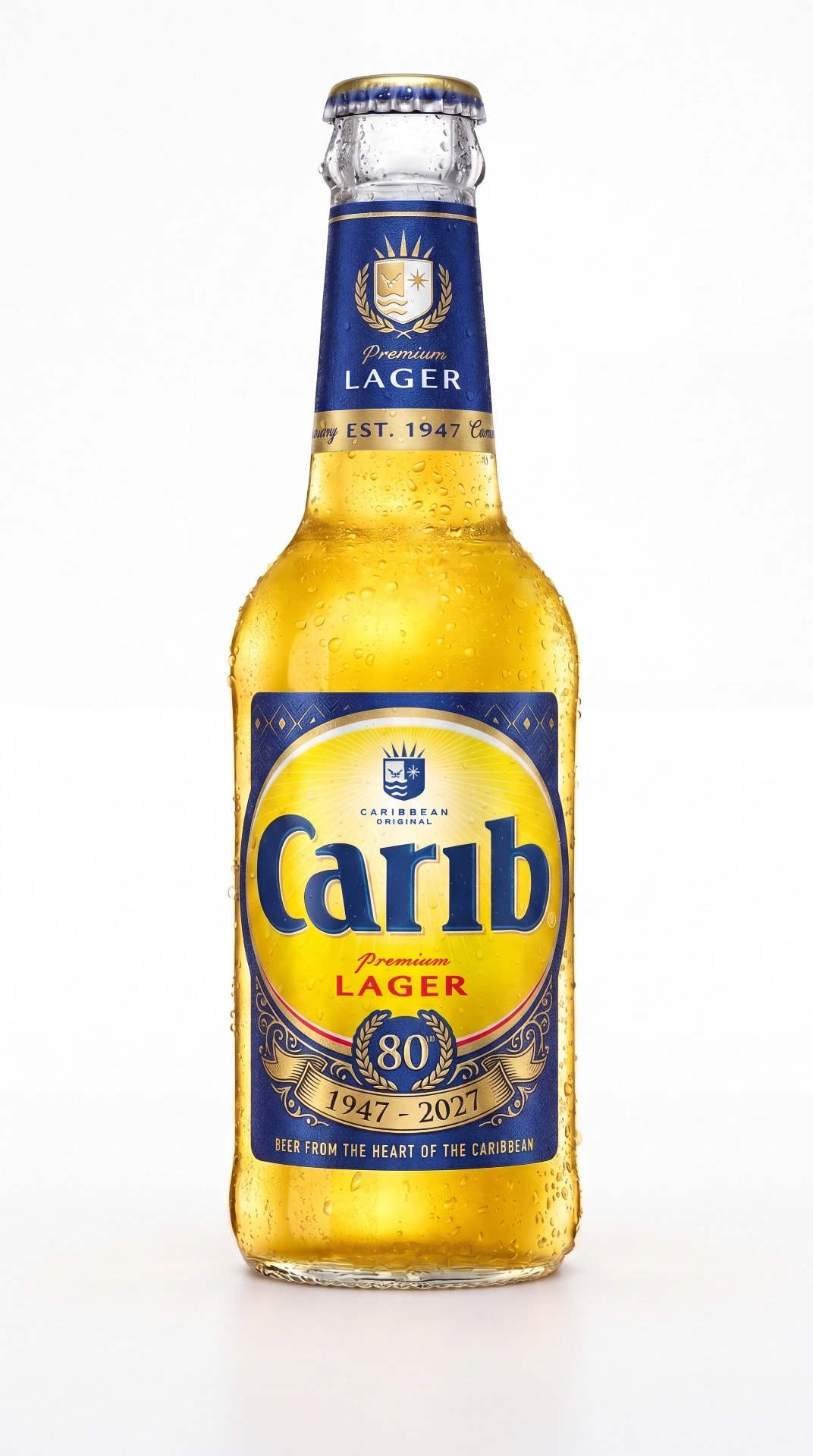
The official Carib Premium Lager 80th Anniversary bottle is the primary Heritage design for the campaign. The portal’s Visual Identity section carries two supplied emblems: the gold Calypso medallion for the Caribbean Gold line (CARIB – CARIBBEAN GOLD – PREMIUM LAGER – EST. 1947) and the steelpan-player emblem for the proposed Caribbean Spirit line (CARIB – CARIBBEAN SPIRIT – PREMIUM LAGER). Supplied emblems are used as exact copies, never redrawn. The earlier Heritage Crest, Solar Modernist and illustrated Goddess Calypso directions are archived. The decision is not to launch every line at once: select a coherent portfolio through consumer comprehension, shelf visibility, print feasibility and supplier cost tests.
Cold Pour has no packaging of its own. The former Cold Pour cans, bottles and six-packs are archived and are not a continuing range. The official Heritage bottle leads the 2027 anniversary, and Caribbean Gold is the proposed line to continue after the commemoration year. The Cold Pour ritual is served with both lines in the signature chalice. The 80 Years · 1947–2027 seal is temporary. No fruit imagery or flavour claims.
The artifact programme includes an embossed 12 oz bottle, matte gold neck foil, numbered chalice, six-bottle collector crate and retro decade 12-pack concepts. These are visual and commercial proposals. Renders are not production artwork; a foil image is not a validated dieline. Bottle dimensions, emboss tolerances, foil application, food-contact compliance, carton strength, decoration durability and minimum order quantities require suppliers’ approval.
Start with the proposed bottle/draft pilot and one 12 oz can six-pack test. Defer the 12-pack and 19.2 oz can until reorders justify added complexity. Collector quantities and numbering are optional concepts, not committed editions. Tooling and foil automation must not be approved simply to satisfy a temporary anniversary treatment.
- Approve naming, label claims and pack feasibility before print.
- Validate one usable chalice system; commemorative decoration must not disrupt service.
- Plan the move from anniversary artwork to the continuing Caribbean Gold line before committing to 2027 stock.
Chapter 05
The 80th campaign: flighting and communications
Anniversary platform and campaign hub
Concentrate media around available product and trained accounts. Awareness without availability risks wasting the milestone.
The proposed campaign spans Q4 2026 through Q4 2027. Q4 2026 establishes the founding-date story and distributor pilot groundwork. Q1 2027 introduces the ‘Born in 1947’ teaser and controlled Cold Pour sampling. Q2 and Q3 carry the heavier anniversary media, retail co-op, creator/press activity and summer occasions. Q4 sustains the ‘Here’s to the Next 80’ narrative, earned-account sampling and selective gifting.
The current 12-flight schedule totals $1.645M. This is an illustrative programme, not approved Carib expenditure. Allocation should follow consumer geography, product availability and the ability to measure incrementality. A proposed Southeast core and selected diaspora corridors are test-market hypotheses; neither account coverage nor distributor commitment is established by the schedule.
Use one creative spine: authentic 1947 heritage, contemporary Caribbean confidence and an unmistakable Carib serve. Connected TV, outdoor and digital should point towards locations where a consumer can actually buy or order Carib. PR and creators should carry specific, verified stories rather than broad claims of popularity, quality superiority or national scale.
There is a calendar conflict to resolve before booking: the stored flagship-event media flight runs Q2–Q3, while the Miami Carnival playbook specifies October 2027. Trinidad Carnival is a separate heritage opportunity with a different calendar and regulatory context. Move or split the relevant flight, secure permissions and confirm the official event date; do not treat the current schedule as a booking-ready Gantt.
Digital demand and proof is the measured digital layer of this plan, not a second campaign. It re-cuts the existing $610K Digital & OOH track, so the $1.645M total does not change. The teaser’s $80K covers social video ($45K) and streaming audio ($35K). The $420K anniversary flight covers connected TV and online video ($160K), mobile and audio near pilot venues and stockists ($110K), outdoor near pilot accounts ($90K), film cut-downs ($30K) and a where-to-buy locator with QR table tents ($30K). The $110K sustain covers retargeting and gifting ($75K) and the geo-test readout ($35K). Outdoor falls to about $90K; more billboard weight around Carnival would come out of connected TV, not out of the test.
Every placement points an adult drinker to a cold pour or a stocked shelf in Miami, Orlando and Tampa, with Jacksonville and Atlanta held as matched controls. Placements must meet the Beer Institute’s 73.8% adult-audience standard; state tied-house limits on retailer-named advertising and US location-privacy law require legal review before booking. A proposed $220K-a-year Caribbean Gold digital programme from 2028 sits in the Caribbean Gold line budget and is released only if the 2027 test passes.
| Workstream | Illustrative total | Purpose |
|---|---|---|
| Trade spend | $470K | Distributor, retail co-op and gifting |
| Digital & OOH | $610K | Teaser, anniversary and sustain; includes the measured digital layer and about $90K outdoor |
| PR moments | $135K | Heritage, events and collector story |
| On-premise sampling | $430K | Pilot, events and earned accounts |
| Total | $1.645M | Reconcile against launch envelope |
- Adult audiences only; apply current legal and industry advertising requirements.
- Confirm inventory, account readiness and measurement design before each flight.
Chapter 06
Flagship activations: operational playbooks
Campaign hub · three proposed event formats
An event is successful when it produces safe, traceable trial and repeat-account demand—not simply a large crowd.
The Trinidad/Miami Carnival concept uses a proposed Miami-Dade route/VIP setting, two 40 ft bars and one chalice lounge, with refrigerated holding, draft backup, shade, water and ID-check lanes. The 40,000-attendee assumption is a planning input, not a verified forecast. Confirm October 2027 Miami timing separately from Trinidad heritage activity. Staffing, throughput and licensed service areas must be sized from validated attendance and permitted service rules.
June Caribbean Week proposes chef-pairing venues in NYC and Miami, restaurants of 80–200 covers, at least two draft lines and a distributor/buyer evening. The 6,000-attendee assumption is unverified. Table tents, story cards and a chalice rail can connect the event to partner accounts. The exact glass stock requirement should be set through turnover, washing capacity and breakage estimates, not copied mechanically from an illustrative ratio.
The Coastal Summer Series proposes eight Florida/Southeast beach or dockside stops in July–August, mobile draft and 5–8 pm occasions. The 18,000-attendee assumption is unverified. Outdoor glass policies, transport, refrigeration, responsible service, weather contingencies and venue licences must be checked before a chalice-led event is promised. Sampling size and age verification are subject to jurisdiction and permit conditions.
Every activation requires an approved run sheet: venue sign-off, responsible-service lead, staffing, cold-chain and chalice-chilling checks, sanitation, waste, incident handling, stock reconciliation and measurement owner. Capture reach, eligible samples, cost per sample and subsequent account depletions. Obtain appropriate consent before collecting consumer data; avoid assuming an attendee becomes a customer.
- POS footprint: Carib fascia, 1947–2027 story, account/store-locator cue and one service explanation.
- Bartender briefing: correct pour, no garnish, standard-glass fallback and responsible-service cut-off.
- Cancellation options: weather reserve, indoor alternative, reduced stock exposure and capped non-refundable deposits.
- Post-event readout: service quality, incremental demand, reorders and retained accounts.
Chapter 07
Cold Pour: the proposed serving ritual
Cold Pour serving ritual and trade guide
Unchanged Carib lager. A frosted signature chalice, one steady pour and a clean collar of foam. Nothing is added.
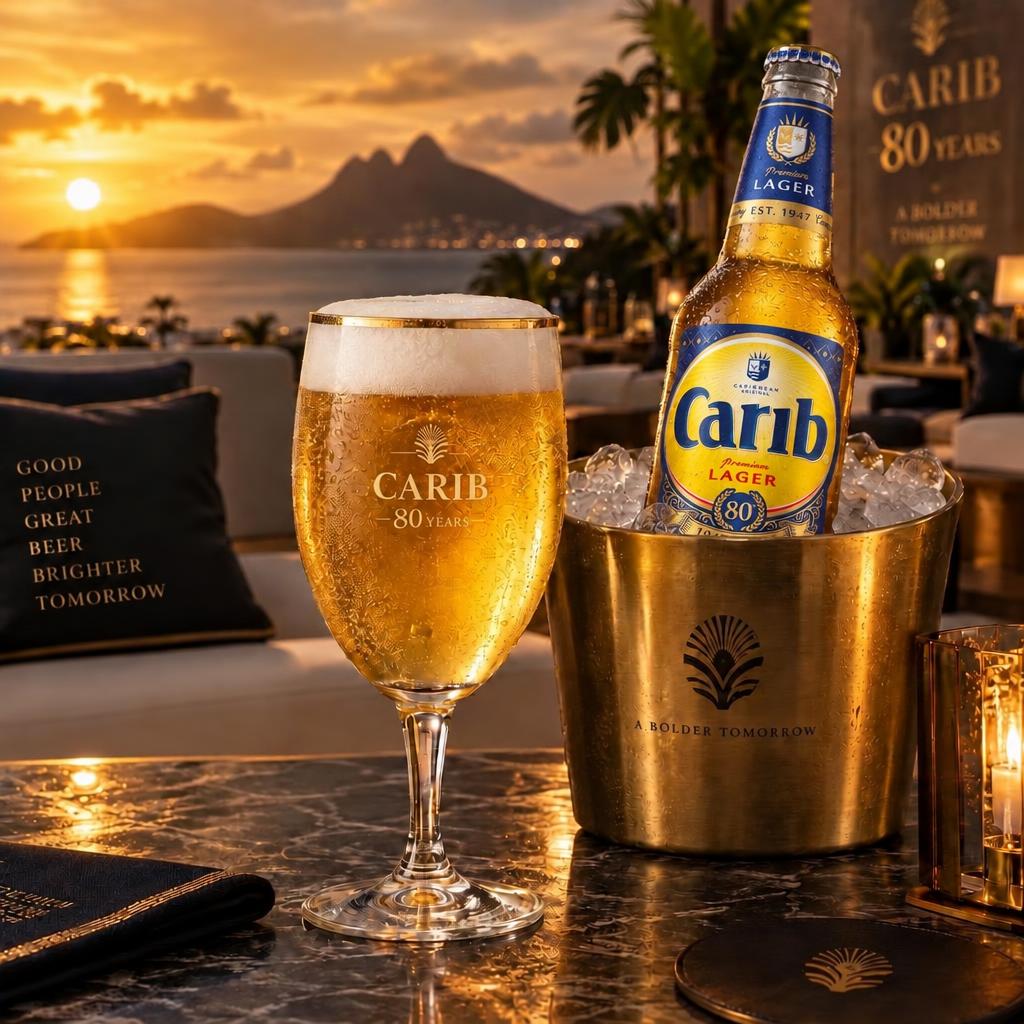
Cold Pour is purely a marketing ritual for serving Carib lagers; it has no packaging, line or recipe of its own. The ice-cold chalice pour separates Carib’s occasion from the familiar lime-in-bottle convention without any fruit gimmick. That is a branding hypothesis, not evidence that the serve improves the beer. Pilot the chalice pour against a standard bottle serve.
The shared policy is explicit: no fruit, wheel, twist or garnish, and no lager recipe change. The ritual is served only with the Heritage and Caribbean Gold lines. Serve in a standard glass if no chilled chalice is available. Validate service time, hygiene, breakage and cost before rollout.
The training sequence is Frost, Pour, Present: chill a beer-clean signature chalice to near freezing and rinse it cold; pour once at 45 degrees, then straighten to finish with a clean two-finger collar of foam, with nothing added; hand the chalice over label-forward and name the line. The trade guide proposes 36–38°F service, a ten-minute module, three observed pours and an eight-question quiz. These are training proposals, not food-safety certification or approved operating specifications.
No garnish is offered, so no fruit preparation procedure is needed; earlier citrus-handling notes are archived. Establish an approved, jurisdiction-appropriate procedure with the food-service operator covering glass chilling, beer-clean checks, chilled-glass handling, breakage and disposal. Confirm gold-rim wash durability and safe use before ordering.
- Primary serve to test: ice-cold chalice pour, nothing added.
- Fallback: standard glass or bottle; never add a garnish.
- Pilot measures: preference, comprehension, service seconds, waste, hygiene and repeat intent.
- Release only after sensory, legal, supplier, operational and economic approval.
Chapter 08
Cold Pour ritual launch: define, pilot, earn expansion
Standalone launch, budget and trade pages
The dates are learning windows. Missing evidence delays the next commitment; the anniversary must not force an unready rollout.
Q4 2026 rebaselines the elapsed Q3 plan. Clear naming and label requirements, check consumer comprehension and pack feasibility, obtain supplier quotations and agree the pilot scope. Distributor interest should become a documented account plan with an inventory and measurement owner. Do not print a broad assortment before the hero pack and serve are understood.
Q1 2027 is a bounded pilot in approved adult-service accounts. Compare the ice-cold chalice pour against a standard bottle serve; observe staff execution, preference, waste, cost and repeat intent. Freeze scale commitments until the GM has a consolidated readout. Q2 introduces trained-account Heritage and Caribbean Gold draught and bottle service only after approval.
Q3 earns expansion through reorders and account-level performance. Broaden distribution where service and shelf execution are repeatable; defer unsupported formats. Q4 2027 into 2028 reviews the anniversary, retires the 80-year seal and moves packaging to the continuing Caribbean Gold line. The Cold Pour ritual continues only if the evidence supports it.
The phase envelope totals $1.45M–$2.60M and excludes the three CapEx gates. These are illustrative ranges, not real Carib numbers or supplier quotes. They overlap with the $1.645M campaign plan and must be reconciled into one approved ledger. Do not present $1.645M plus $2.60M as an authorised combined programme. The $2M launch input in the valuation model is a separate scenario convention that must be aligned to that ledger.
| Phase | Planning range | Release evidence |
|---|---|---|
| Q4 2026 · Define & clear | $150K–$250K | Clearance, comprehension, quotes |
| Q1 2027 · Pilot & learn | $200K–$350K | Safe, understood, repeatable serve |
| Q2 2027 · Selective launch | $600K–$1M | Trained accounts and available stock |
| Q3 2027 · Earn expansion | $400K–$800K | Reorders and sustained execution |
| Q4 2027–2028 · Retain | $100K–$200K | Review; move to Caribbean Gold line |
- No approved account count, performance target or budget exists in the current brief.
- Specify pass/fail thresholds with Carib before the pilot begins.
Chapter 09
Distributor sell-in and pricing discipline
Distributor sell-in kit and Cold Pour trade guide
Sell a coherent account proposition: credible heritage, existing lager, recognisable service and evidence-led support.
The proposed first account tier is Caribbean/Latin dining and patio/coastal bars in Miami/South Florida. The second is Southeast premium-import bars and selected independent retail. Regional chain grocery and convenience expansion are earned later. These are targeting hypotheses, not signed accounts. Distributor agreements, territory rules, inventory terms and sell-through support need market-by-market review.
Trade should understand that Cold Pour is a way of serving the existing Carib lagers, not a new beer or pack. The 80th anniversary gives a dated reason to engage; the ice-cold chalice gives the bartender a memorable explanation. Cape Canaveral is a user-supplied operating-platform fact, but specific ‘brewed in Florida’ pack claims and lead-time promises must match the actual SKU and verified supply route.
The six-pack proposal is $6.50 FOB / $8.75 wholesale / $11.99 suggested retail for cans and $6.75 / $9.00 / $12.49 for bottles. The keg proposal is $75 FOB / $105 wholesale for a sixth-barrel and $170 / $225 for a half-barrel. These are illustrative prices, not approved terms or mandated retail prices. Taxes, freight, allowances, deposits, breakage and returns must be mapped consistently before negotiating.
At $225 half-barrel wholesale cost, 1,890 usable ounces, a 14 oz pour, no garnish cost and an $8 menu price, the guide models 135 pours and roughly $1.67 ingredient cost per pour. The resulting approximately 79.2% ingredient gross margin excludes labour, glassware, service waste beyond the usable-ounce assumption, venue overhead and other operating costs. It is not the retailer’s net profit.
- Distributor margin = (wholesale − FOB) / wholesale; do not confuse margin with markup.
- Indicative trade-spend and co-packer ranges remain unverified until quoted.
- Excise applicability depends on production/import structure and eligibility; do not assume the reduced federal rate applies to Carib.
- Validate price elasticity and deductions in pilots; optimiser outputs are hypotheses, not approved prices.
Chapter 10
Supply roadmap and contingent equipment capital
Slides 10–13 · manufacturing and CapEx diligence
Use a blended operating model to learn before locking in fixed-cost capacity. Equipment is an evidence-gated enabler, not the launch strategy itself.
The phased proposal uses existing operating capability and external packaging support where feasible, then selectively internalises capacity as sustained volume and quality requirements become clear. Cape Canaveral, co-packer availability, SKU-specific origin, throughput, minimum order quantities, freight and inventory working capital require an operational audit. The current materials are not an approved plant plan.
Gate 1 is $3.5M for cellar and fermentation. Gate 2 is $5M for rotary canning. Gate 3 is $4M for automated bottling and foil. These amounts were supplied as planning gates; the model adds assumed per-case savings of $0.80, $1.50 and $1.00 respectively. Savings are not measured Carib outcomes and must be net of labour, maintenance, utilities, scrap, depreciation/tax effects and displaced outsourcing costs.
Public project comparisons put Gate 1 broadly within selected expansion examples, but are not comparable supplier quotes. Gate 2’s $5M appears low relative to cited high-speed integrated lines; it may describe a different speed, scope or refurbished solution. Gate 3’s suggested comparison range is unverified. Do not relabel these amounts as validated high-speed project budgets.
Before release, require a capacity/bottleneck study, competitive installed-cost quotes, utilities and civil scope, commissioning downtime, quality validation, throughput/OEE, maintenance, operator training and a financing plan. A limited anniversary foil treatment should not itself justify permanent automation. Evaluate manual, supplier-applied or outsourced treatment against the continuing Caribbean Gold volume case.
| Gate | Planning capital | Assumed savings/case |
|---|---|---|
| 1 · Cellar & fermentation | $3.5M | $0.80 |
| 2 · Rotary canning | $5.0M | $1.50 |
| 3 · Bottling & foil | $4.0M | $1.00 |
| All gates | $12.5M | $3.30 once all live |
- Budget gate capital separately from launch cash.
- Shared model savings begin after the release year, not during commissioning.
- Release gates individually; use retained demand and operational need, not a calendar alone.
Chapter 11
Capital perspective: judge the path to 2030
Slide 16 and the CapEx / Strategy Lab 2030 views
A brand-building outlay may be justified without launch-year break-even. It still needs a credible, risk-adjusted path to durable cash generation.
Initial media, sampling, design and training can build awareness and trade capability beyond 2027. That is the strategic reason not to judge the whole plan on first-year profit. It is not an accounting claim that every expense creates a balance-sheet asset. Future commitments remain avoidable before approval; once incurred, sunk costs should not be used as a reason to continue a failing programme.
The base valuation scenario uses 150,000 cases in 2027 rising geometrically to 1.2M in 2030, $22 net revenue per case, a 12% EBITDA margin before gate savings, a 12× EBITDA multiple, a 10% discount rate and $2M launch spend split 40% in 2026 and 60% in 2027. Base gate timing is Gates 1 and 2 in 2028 and Gate 3 in 2029. Every figure is a planning assumption, not a Carib forecast or independent valuation.
Under those assumptions, launch-year cash is approximately −$804K, yet 2030 EBITDA is $7.128M after all gate savings and modelled EV is $85.536M. Discounted 2026–2030 cash plus discounted 2030 EV is approximately $54.6M; peak modelled cumulative cash need is about $10.34M including gate capital. These numbers illustrate why the decision horizon matters, not what Carib is worth today.
The model is a decision proxy, not a complete valuation: EBITDA is used as cash before a full treatment of tax, working capital, maintenance capex, debt, lease obligations or ownership dilution. Enterprise value is not equity value. Do not book awareness or EMV as financial value. Finance should replace assumptions, challenge the multiple and growth ramp, reconcile cash needs and independently validate the investment case.
- Downside: 400K cases, 9% margin and 9× multiple in 2030.
- Base: 1.2M cases, 12% margin and 12× multiple.
- Upside: 2.5M cases, 15% margin and 15× multiple.
- Compare gate/no-gate cases on the same assumptions; report incremental value after capital, not only terminal EV uplift.
Chapter 12
Measurement: brand progress and attributable value
KPI framework, Strategy Lab and campaign impact estimator
Measure what the campaign changes. The entire brand’s enterprise value must never be credited to one anniversary programme.
A balanced scorecard starts with awareness, consideration and distinctiveness among the intended adult audience. Add distribution quality, availability, bartender execution and stockouts, then trial, repeat purchase, account retention, reorders and depletions. Volume shipped to a distributor is not automatically consumer demand. Set baseline periods, matched comparisons and data ownership before launch.
The campaign estimator calculates consumer cases from eligible attendees, sample rate, conversion and cases per convert. It calculates account lift from account count, incremental monthly cases and duration. It subtracts overlap between the streams, then applies campaign attribution. Retention and expansion carry only the attributed increment towards 2030. These are controllable assumptions until observed data replaces them.
The current defaults use 64,000 attendees, 35% sampling, 18% conversion, 1.5 cases per convert, 300 accounts, eight incremental cases monthly for six months, 100% overlap and 50% attribution. That implies 7,200 attributable launch-year cases, not 20,448 additive cases. With 75% retention and 25% expansion, the annual carry factor is 0.9375: the attributable cohort shrinks unless retention or expansion improves.
The estimator compares identical gate/baseline scenarios, calculates incremental cash and 2030 EV uplift and discounts both to 2026. The base 2027 EBITDA contribution is $2.64 per case ($22 × 12%), aligned with the CapEx view. EMV—impressions divided by 1,000 times CPM—is only a media-equivalence reference. It is neither cash, measured sales nor enterprise value and is excluded from the investment verdict.
Digital is held to the same rule. At $2.64 contribution per case, repaying the $420K anniversary digital flight from 2027 margin alone would need about 159,000 extra cases, so it cannot be justified on first-year margin. Using the shared model’s defaults, it needs about 7,500 attributable extra 2027 cases, roughly 5% of the 150,000-case base, retained towards 2030 to add value. The whole $610K track needs about 10,900; the proposed $220K 2028 programme about 3,900. These are planning hurdles that move with every assumption, not forecasts.
Decision rule: release the 2028 Caribbean Gold digital programme only if the Q3 2027 readout shows a clear positive lift in the treated markets against the controls and the annualised incremental cases meet the value hurdle. Otherwise hold at measurement-only spend. Platform-reported ROAS, impressions, views and follower counts may be reported for context but never drive a decision.
| Rhythm | Tools (examples) | Metric to act on | Action it triggers |
|---|---|---|---|
| Daily | Ad platforms and ad server (e.g. The Trade Desk, Google Campaign Manager 360, Meta) | Pacing; cost per locator visit by market; adult-audience share | Shift budget between markets weekly; pause any placement below 73.8% adults |
| Weekly | Distributor depletion data (e.g. VIP) and scan data (e.g. NielsenIQ, Circana) | Cases per account per week, treated vs control | Flag accounts for extra sampling or bartender training |
| Weekly | Where-to-buy tool (e.g. MikMak, Destini) and QR scans | Locator searches, directions and add-to-cart by market | Fix stock gaps with distributors before spending more |
| Quarterly | MarketMix 2030 geo-lift and the War Room | Incremental cases and lift against control | Go / hold decision for 2028 support |
- Keep 2027 contribution/ROI as a diagnostic, separate from incremental 2030 value.
- Use controlled account cohorts and independent depletion readouts to estimate lift.
- Track the cost of retained accounts and repeat buyers, not only the cost of samples.
- Brand lift can be strategically important without being assigned an invented monetary value.
- Vendor names are examples, not purchase recommendations; Carib’s agency and distributors confirm the stack.
Chapter 13
Strategy testing, optimisation and decision limits
Strategy Lab · frameworks and 2030 optimiser
Use the model to reveal dependencies and downside exposure, not to manufacture certainty from illustrative inputs.
SWOT tests the strength of heritage and the risks of narrow awareness or operational stretch. Porter’s Five Forces examines distributor and retailer power, substitutes, rivalry and entry barriers. PESTLE surfaces economic, legal, cultural and operational constraints. Ansoff compares penetration and market development against more complex product or market moves. The 7P mix links product, price, place, promotion, people, process and physical evidence to actual execution.
The 2030 view reuses the CapEx economics, growth ramp and valuation conventions. Seeded Monte Carlo shocks demand and costs to show distributions of value and cash requirements. The optimiser compares pricing, trade deductions, market direction and gate choices under separate launch-cash and gate-capital ceilings and a user-selected probability floor. The year-one comparison remains a diagnostic, not the primary strategic objective.
The model’s grid and random draws are reproducible, but the probabilities are conditional on its distributions, correlations, elasticity and scoring assumptions. A +10% price recommendation depends on consumer response. Lower trade deductions may fall below indicative market norms and undermine distribution support. Gate 2 can look attractive on assumed savings while its installed-cost budget remains under-scoped.
Use results to design experiments: test price bands in matched accounts, validate deductions with distributors, quote capex scope, measure packaging costs and collect repeat behaviour. Finance should review the model’s treatment of cash and terminal value. A high simulated value is not evidence that a market will accept the pack or that a financing source will fund the gates.
- Challenge cases2030, net/case, margin, multiple, discount and gate savings together.
- Stress distribution delays, weak reorders, cost overruns and lower retention.
- Include no-gate and slower-expansion alternatives; do not assume every gate is necessary.
- Use LTV:CAC and break-even for channel diagnostics, not as substitutes for the 2030 strategic mandate.
Chapter 14
Governance, risks and the GM’s decision
Slide 16 · executive ask and next actions
Approve the strategic ambition, fund the next evidence step and hold the line on responsible execution.
The proposed governance group brings brand, commercial, operations, finance and legal/compliance together under a GM sponsor. Named individuals and dates remain to be assigned by Carib. Brand owns one identity and the transition from anniversary artwork to the continuing Caribbean Gold line; commercial owns distributor/account readiness; operations owns supply and service feasibility; finance owns the reconciled ledger and valuation assumptions; legal owns claims, licences, advertising and commercial arrangements.
Before pilot approval, resolve naming and label clearance, adult-audience targeting, responsible service, venue permits, food handling and data consent. Review three-tier restrictions, inducement/tied-house exposure, promotion terms and state-specific sampling rules with qualified counsel. Published tax rates are context, not proof of Carib eligibility. No generic training module or web document replaces a licensed operator’s obligations.
The main commercial risks are misunderstood flavour cues, weak reorders, fragmented creative and unsupported price premiums. Operational risks include glass breakage, chilled-glass handling, pack MOQs, stockouts, incompatible foil equipment and commissioning delays. Capital risks include underestimated installed cost, multiple compression, aggressive volume ramps and insufficient funding. The controls are smaller tests, explicit stop/hold rules, quoted scope and a fully financed downside—not confidence in the anniversary date.
The executive ask is fourfold: endorse mainstream brand elevation as the 2030 ambition; approve the anniversary, Caribbean Gold and Cold Pour ritual architecture; authorise a bounded diligence and pilot package once an approved budget is reconciled; and require evidence-led decisions on rollout and each CapEx gate. Do not ask the board to approve the $85.536M scenario as a valuation conclusion or the current planning ranges as expenditure commitments.
- Immediate inputs needed: Carib case volumes, net revenue, trade deductions, costs, awareness, account base and available capital.
- Before booking: official event dates, licensed venues, adult-audience media plan and agreed measurement thresholds.
- Before printing: supplier-approved artwork, pack claims, quantities and the stock transition to the continuing Caribbean Gold line.
- Before CapEx: installed-cost quotes, operating savings, capacity evidence and finance sign-off.
- Success by 2030: stronger recognition, sustained consumer demand, retained distribution and credible cash generation.
Chapter 15
Evidence register and reading guide
Sources, caveats and companion references
This document consolidates the current portal and executive deck. It adds no claim that Carib has approved or achieved the illustrative programme.
User-supplied foundations are Carib’s 1947 Trinidad & Tobago heritage, the 1947–2027 anniversary, the Cape Canaveral operating platform and the three original gate amounts. The strategic architecture, packaging proposals, account tiers, launch windows, prices, media budgets, attendance, conversion, gate savings and valuation defaults are planning recommendations or model assumptions.
The portal’s public-source register was checked on 28 October 2026. This companion reproduces that register; it does not claim a fresh independent verification of each source. Time periods, units, eligibility and project scope must be checked before use in a finance or legal submission. US market figures are background context, not evidence of Carib’s share or likely growth.
Federal and Florida excise pages are primary references, but actual tax treatment depends on structure and eligibility. Beer Institute and Brewers Association material provide aggregate market context. Brewbound and other project reports illustrate launches and equipment scope. A $1M craft extension and an historical $40M national import launch are not like-for-like comparables for Carib; they do not validate the $1.45M–$2.60M phase envelope.
Generic industry homepage links do not substantiate specific distributor margins, co-packer rates or trade-spend ranges. Those assumptions remain unverified. Gate 3’s comparison range is also unverified. Obtain quotations and Carib actuals. Read the deck for the concise decision narrative; this companion for the underlying logic; the portal’s interactive models for sensitivity analysis; and approved operating documents, once issued, for execution.
- Document control: edition 4 accompanies executive deck edition 13; later model inputs may change.
- Financial frame: US dollars; 2026 present-value basis; assumptions explicitly separated from facts.
- No national rollout, production specification, account target or expenditure is approved by this document.
- Source links and model snapshot follow; reconcile all numbers to Carib’s final finance pack.
Source links
Portal register checked 28 Oct 2026; not re-verified for this edition. ‘Verified’ describes the existing register, not applicability to Carib.
Federal beer excise, domestic brewer <2M bbl/yr (first 60,000 bbl)
$3.50 per barrel; $16 to 6M bbl; $18 above · Register: verified
https://www.ttb.gov/taxes/tax-audit/tax-and-fee-ratesFlorida malt beverage excise
$0.06 per 12oz container; $0.48 per gallon in kegs · Register: verified
https://www.flsenate.gov/Laws/Statutes/2026/563.05Imported share of US beer consumption
≈18% of volume · Register: verified
https://www.beerinstitute.org/data-economic/import-export/US beer market size and trend
$113B retail; production + imports −5.7% in 2025 · Register: verified
https://www.brewersassociation.org/statistics-and-data/national-beer-stats/Import volume softness
Import volume −14.9% YoY (Apr 2025) · Register: verified
https://www.brewbound.com/news/beer-institute-april-beer-supply-5-8-as-import-volume-falls-14-9/Three-tier margins
Distributor ≈25–30% of wholesale; retailer ≈25–30% of shelf · Register: unverified
https://www.nbwa.org/Co-packer canning cost
≈$6–10 per 24-can case plus printed-can MOQs (often 100K+ cans) · Register: unverified
https://www.brewbound.com/Trade spend for challenger imports
≈15–25% of net sales in launch markets · Register: unverified
https://www.beerinstitute.org/Launch spend benchmark: brand extension by a large US craft brewer
New Belgium invested ≈$1M behind Juice Force launch (2022) · Register: verified
https://www.brewbound.com/news/juice-force-hazy-imperial-ipa-on-pace-to-be-top-4-voodoo-ranger-brand-in-2022-new-belgium-invests-1-million-in-launch/Launch spend benchmark: national import launch by a global brewer
Brahma US launch budget ≈$40M (InBev) · Register: verified
https://e-malt.com/newssrv.asp?ArticleID=4859&Command=ArticlePrinterFriendly&SKey=
Equipment project references
Gate 1 · Cellar & fermentation
https://www.brewbound.com/news/widmer-brothers-invests-3-million-in-portland-brewery-expansion/https://www.thepitchkc.com/boulevard-breaks-ground-on-cellar-five-expansion/Gate 2 · High-speed rotary canning
https://www.fifcousa.com/news/2025/3/20/new-can-line.htmlhttps://www.canmakingnews.com/issues/latest/carlsberg-invests-e12m-in-new-ukraine-canning-line-as-brewery-capacity-expands/Gate 3 · Automated bottling & foil
https://www.asahibeerusa.com/news-AsahiBeerUSA-New-Bottling-Line-at-Octopi-FacilityCurrent shared service guardrails: No fruit, wheel, twist or garnish of any kind, and no change to the lager recipe. Chill the chalice and the lager; serve in a standard glass or bottle if a chilled chalice is unavailable. Validate service time, hygiene, glassware handling, breakage and cost before rollout.